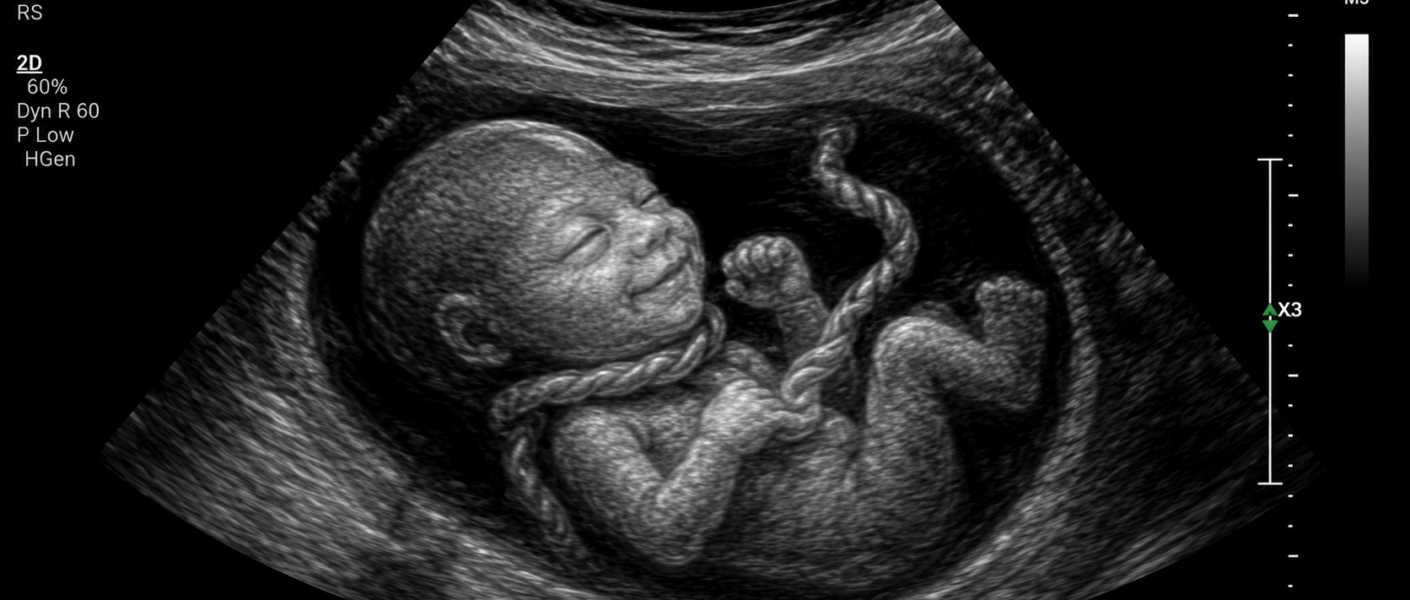
This is one of those topics that can bring immediate fear to expecting families. When an ultrasound shows that the umbilical cord is around the baby’s neck, many pregnant moms instantly think of fetal distress, an urgent C-section, or serious danger.
But in most cases, a nuchal cord does not mean an emergency. It is relatively common, it may appear and disappear during pregnancy, and many babies with a cord around the neck are born healthy, without major complications.
What matters most is understanding when this finding simply needs monitoring and when it may affect decisions about fetal surveillance, labor, delivery, and the baby’s safety.
What does it mean when the cord is around the baby’s neck during pregnancy?
A cord around the neck, also called a nuchal cord, happens when one or more loops of the umbilical cord are wrapped around the baby’s neck.
The umbilical cord is flexible and protected by a soft, jelly-like substance called Wharton’s jelly, which helps protect the blood vessels from compression. Because of this, the simple fact that the cord is around the baby’s neck does not necessarily mean it is “tight” or harming the baby.
During pregnancy, babies move, turn, stretch, and change positions often. Since the cord also floats and moves inside the amniotic fluid, it can sometimes wrap around part of the baby’s body, including the neck.
Why can the umbilical cord wrap around the baby’s neck?
A nuchal cord is usually related to normal fetal movement. Active babies, more amniotic fluid, longer umbilical cords, and enough space inside the uterus can make this more likely to happen.
This does not mean the mother did anything wrong. Sleeping on a certain side, walking, having sex, lifting moderate weight, or moving around during daily life does not “cause” the cord to wrap around the baby’s neck.
It is an anatomical and dynamic part of pregnancy, not a direct result of something the mother did or failed to do.
Is a cord around the neck always dangerous?
In most cases, no. An isolated nuchal cord, especially when there is only one loose loop, usually has a good outcome.
Concern may be higher when there are additional factors, such as multiple loops, a tight cord, ongoing changes in the baby’s heart rate, fetal growth restriction, decreased fetal movement, or other pregnancy-related concerns.
Still, decisions should not be based only on the ultrasound image. The full clinical picture matters: gestational age, fetal well-being, growth, amniotic fluid levels, Doppler results, pregnancy history, and how labor progresses all need to be considered together.
What is more concerning: one loop or multiple loops?
A single loop is usually less concerning. Multiple loops may need closer attention, especially if there are signs of cord compression or changes in the baby’s oxygenation.
Even so, several loops do not automatically mean the baby is in immediate danger. The OB-GYN or maternity care team looks for real signs of fetal compromise, not just the presence of the cord.
How is a nuchal cord diagnosed?
A nuchal cord is usually seen during an obstetric ultrasound, often with the help of color Doppler, which can show blood flow in the umbilical cord.
Sometimes the ultrasound report may mention “nuchal cord” or “cord around the fetal neck.” This finding can feel scary, but it should be interpreted carefully because the cord’s position can change before birth.
Ultrasound can help identify the presence of the cord, but it cannot always accurately predict whether the cord will be tight at delivery or whether it will cause any issue during labor.
What care is recommended during pregnancy?
When a nuchal cord is found, the main recommendation is usually to continue regular prenatal care. Most of the time, no immediate intervention is needed.
Your healthcare provider may recommend additional evaluation if there are other warning signs, such as decreased fetal movement, changes in the baby’s growth, low amniotic fluid, or abnormal Doppler findings.
Pregnant moms are also usually encouraged to pay attention to the baby’s movement pattern, especially in the third trimester. The goal is not to compare one pregnancy with another, but to notice meaningful changes in that baby’s usual pattern.
When should you seek medical care right away?
You should contact your healthcare provider or go to labor and delivery triage if you notice a significant decrease or absence of fetal movement, vaginal bleeding, leaking fluid, severe pain, regular contractions before the expected time, or any symptom that feels unusual or concerning.
In these situations, medical evaluation may include listening to the baby’s heartbeat, fetal heart rate monitoring, ultrasound, or other tests depending on gestational age and symptoms.
Does a cord around the neck mean a C-section is required?
No. A nuchal cord by itself is not an automatic reason for a C-section.
Many babies with a nuchal cord are born vaginally without complications. During delivery, the provider may check for a loop of cord and, when possible, gently slip it over the baby’s head after the head is born.
A C-section may be needed if there are signs of fetal distress, persistent changes in the baby’s heart rate, labor that is not progressing safely, or other obstetric indications. The decision should always be individualized.
How is the baby monitored during labor?
During labor, the care team monitors the baby’s heart rate. This helps show whether the baby is tolerating contractions well.
Sometimes temporary cord compression can cause changes in the heart rate called variable decelerations. Not every deceleration means danger, but patterns that are persistent, deep, or associated with other concerning signs may require action.
Possible steps may include changing the mother’s position, giving fluids, evaluating contraction strength, and, when necessary, considering an obstetric intervention.
What should be discussed with the medical team?
The safest decisions usually come from combining medical information with careful listening to the pregnant mother’s concerns.
It can help to ask about gestational age, the number of loops, whether the cord appears loose or tight, whether fetal growth is normal, how the Doppler results look, what symptoms should lead to a hospital visit, and under what circumstances a C-section would be considered.
These questions help turn fear into clarity. The goal is not to ignore the finding, but also not to treat it as a guaranteed complication.
How can you cope emotionally with this diagnosis?
Hearing that the cord is around the baby’s neck can understandably cause anxiety. The image alone can feel frightening for any family.
But from an obstetric point of view, a nuchal cord is a common finding and is often not dangerous. Emotional care matters too. Getting clear explanations, avoiding rushed conclusions, and staying in touch with the prenatal care team can help reduce fear.
Reliable information cannot remove every risk from pregnancy, but it can support calmer, more balanced decisions.
What really matters when the cord is around the baby’s neck?
A cord around the baby’s neck during pregnancy should be taken seriously, but it should not automatically be seen as an emergency. In most cases, especially when it is an isolated finding, proper monitoring is enough.
The key is to look at the baby as a whole: fetal movement, growth, amniotic fluid, Doppler results, heart rate, and how labor progresses.
A safe pregnancy does not depend only on finding something on an ultrasound. It depends on interpreting each finding in the right context. When families and healthcare professionals communicate clearly, decisions become more informed, calm, and compassionate.
References
PubMed / PLOS One — Umbilical cord characteristics and their association with adverse pregnancy outcomes: a systematic review and meta-analysis:
https://pubmed.ncbi.nlm.nih.gov/32970750/
PubMed — Nuchal cord is not associated with adverse perinatal outcome:
https://pubmed.ncbi.nlm.nih.gov/16374604/
NIH / PMC — Electronic Fetal Monitoring and Neonatal Outcomes when a Nuchal Cord Is Present at Delivery:
https://pmc.ncbi.nlm.nih.gov/articles/PMC7472605/
NIH / PMC — Standardized Ultrasound Diagnosis of Nuchal Cord:
https://pmc.ncbi.nlm.nih.gov/articles/PMC8455514/
ACOG — Fetal Heart Rate Monitoring During Labor:
https://www.acog.org/womens-health/faqs/fetal-heart-rate-monitoring-during-labor
Most Read Posts

Postpartum Care

Baby Sleep

Breastfeeding

Infant Formula

Baby Bottles

Feeding Your Baby

Diapering & Bathing

Health & Development

Milestones & Development

Colic & Fussiness

Baby Gear & Safety

Traveling with Baby
Recent posts
- Liquid vs. Powder Baby Formula: Which Is the Better Value?
 Compare liquid vs. powder baby formula, including cost, convenience, safe preparation, storage, and which option may be best for your baby.
 - How Do I Know If I’m Ready to Care for a Newborn?
 Learn how to know if you’re ready to care for a newborn, with gentle guidance on feeding, safe sleep, warning signs, and emotional support.
 - First Baby: What If I Feel Lost in the First Few Days?
 Feeling lost with your first baby? Learn what is normal in the first newborn days, when to ask for help, and how confidence grows with time.
 - Is a Folding Stroller Durable Enough for Everyday Use?
 Is a folding stroller durable enough for everyday use? Learn what affects strength, safety, weight limits, and long-term performance.
 - Pregnant for the First Time: What Should You Do in the First Few Weeks?
 Pregnant for the first time? Learn what to do in the first few weeks, including prenatal care, nutrition, folic acid, and warning signs.
 - How to Support Your Partner During Labor and Delivery
 Learn how to support your partner during labor with practical tips for comfort, communication, pain relief, and emotional reassurance.
 - Can a Bedside Sleeper Help First-Time Moms?
 Can a bedside sleeper help first-time moms? Discover its benefits, safety tips, and how to choose the right option for your baby.
Click here to read the article in Portuguese

I’m Cris Coelho, and motherhood has transformed my life!
As a speech therapist and early childhood educator, I’ve always been passionate about child development. But it was becoming a mother that truly opened my eyes to the real challenges and joys of this journey.
Here at Materníssima, I share everything I’ve learned — blending professional knowledge, real-life experience, and a heartfelt touch.
You’re very welcome here! 💕