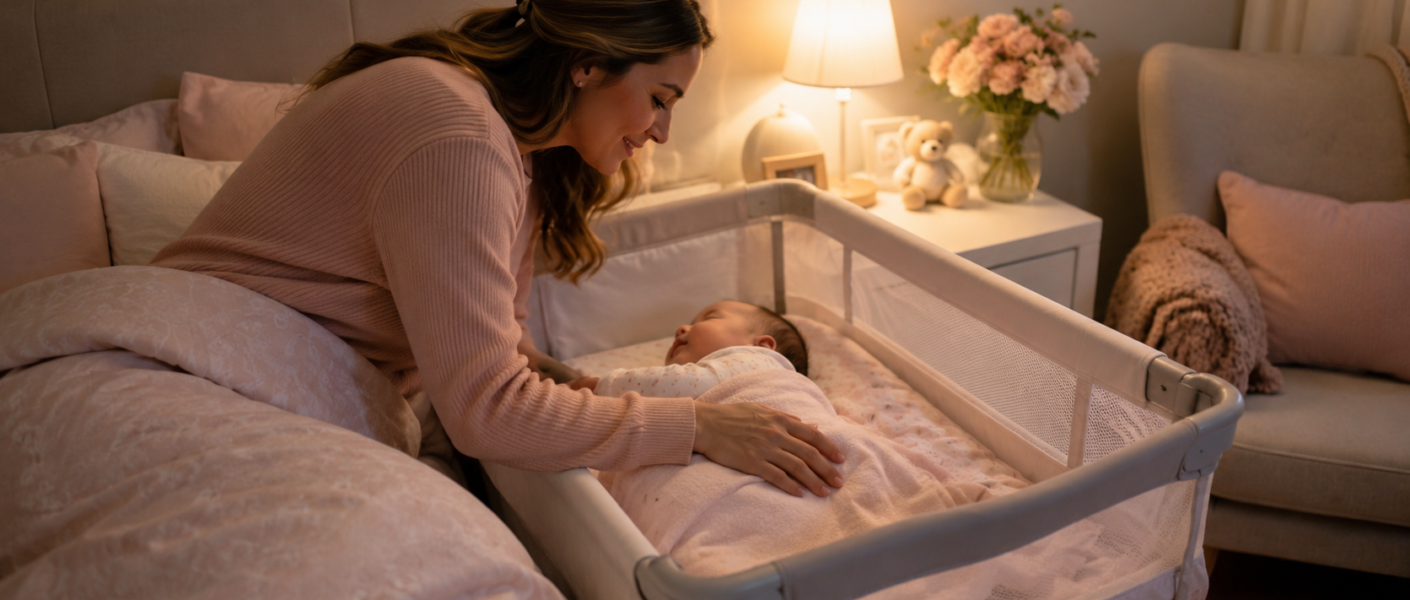
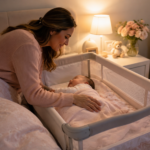
Can a bedside sleeper help first-time moms? Yes, it can be especially helpful during the first few months, when families are still adjusting to nighttime feedings, diaper changes, frequent wake-ups, and a brand-new sleep routine.
However, a bedside sleeper is only truly helpful when it is used correctly and follows current infant safe-sleep recommendations.
A bedside sleeper allows your baby to sleep close to you while still having a separate sleep surface. That distinction matters: keeping your baby nearby does not mean sharing the same bed.
What Is a Bedside Sleeper?
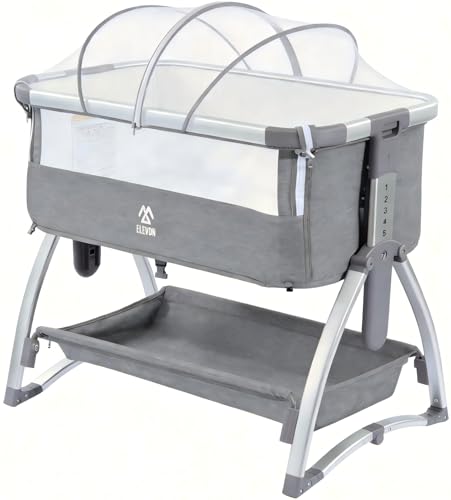
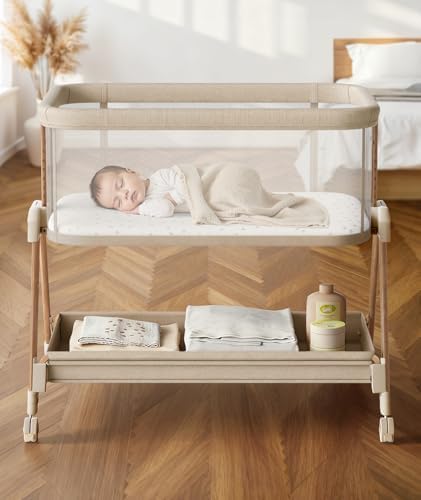
A bedside sleeper is a small infant sleep space designed to sit next to an adult bed. Some models have a side panel that lowers and a secure attachment system that connects the sleeper to the parents’ bed, making it easier to reach the baby during the night.
Bedside sleepers are designed to simplify nighttime care, especially during the newborn stage, when babies often wake to feed, be comforted, or have their diapers changed.
What Is the Difference Between a Bedside Sleeper and Bed-Sharing?
With a bedside sleeper, the baby remains on a separate sleep surface designed specifically for infants. With bed-sharing, the baby sleeps on the same mattress as one or more adults.
This difference is extremely important.
Major infant-safety guidelines recommend room-sharing without bed-sharing. An adult bed may contain pillows, loose blankets, soft bedding, mattress gaps, and other potential hazards that are not appropriate for infant sleep.
A bedside sleeper can give families the comfort of having their baby close while maintaining a separate sleep space.
Why Can a Bedside Sleeper Help First-Time Moms?
Becoming a mother for the first time often comes with questions, uncertainty, and intense exhaustion. Having your baby nearby may provide reassurance because it becomes easier to notice early hunger cues, respond to wake-ups, and check on your baby without walking to another room.
For many new moms, this closeness also makes the transition home feel less overwhelming.
Your baby is within reach, but still has a separate place to sleep. That arrangement may offer a helpful balance between connection, convenience, and safety.
Can a Bedside Sleeper Make Breastfeeding Easier?
Yes, it may make nighttime breastfeeding more convenient.
During the first few months, many babies feed several times throughout the night. When your baby is sleeping beside your bed, you may notice early hunger cues—such as gentle movements, soft sounds, rooting, or bringing hands toward the mouth—before your baby begins crying.
Responding to these early cues may help feedings feel calmer for both you and your baby.
A bedside sleeper can also reduce the number of times you need to get out of bed and walk across the room. This may be especially helpful during postpartum recovery if you are experiencing soreness, exhaustion, limited mobility, or discomfort after a C-section.
After feeding, always return your baby to their own safe sleep space before you go back to sleep.
Can a Bedside Sleeper Help a New Mom Sleep Better?
A bedside sleeper may improve your sense of reassurance and make nighttime care more manageable. However, it does not mean that you or your baby will sleep through the night.
Newborns have short sleep cycles and wake frequently for feeding, comfort, and diaper changes. Frequent waking is developmentally normal during the early months.
The main benefit of a bedside sleeper is convenience. Instead of getting up repeatedly and walking to a separate nursery, you can respond to your baby more easily.
That may reduce some of the physical effort involved in nighttime caregiving, even when your sleep is still interrupted.
Can Having the Baby Nearby Help a Mom Feel More Reassured?
It can.
First-time moms often feel the need to check whether their baby is comfortable, breathing normally, or beginning to wake. A bedside sleeper makes it easier to look over and respond when needed.
At the same time, it is important to find a healthy balance between awareness and rest. Your body needs sleep and recovery, too.
Having your baby nearby should provide support and comfort—not create pressure to remain awake and watch your baby throughout the night.
If worry about your baby’s sleep or breathing is keeping you from resting, speak with your pediatrician or healthcare provider.

Is a Bedside Sleeper Safe?
A bedside sleeper can be safe when it meets current safety standards, is assembled correctly, and is used exactly as instructed by the manufacturer.
The sleep surface should be firm, flat, level, and free of any incline. The mattress should fit the product properly without gaps around the edges.
Always place your baby on their back for every sleep, including naps.
The sleeper should remain free of pillows, loose blankets, crib bumpers, stuffed animals, sleep positioners, loungers, baby nests, and padded accessories.
What Should Never Be Placed Inside a Bedside Sleeper?
For sleep, the bedside sleeper should contain only your baby and a fitted sheet designed for that specific mattress.
Soft items may increase the risk of suffocation, airway obstruction, or entrapment. Even products that appear soft and comfortable may make the sleep environment less safe.
For babies, the safest sleep space is simple:
- A firm, flat mattress
- A properly fitted sheet
- No loose bedding or soft objects
- Baby placed on their back
If your baby needs warmth, use appropriate sleep clothing or a wearable blanket rather than a loose blanket.
What Safety Steps Are Important During Assembly?
The bedside sleeper should be completely level and firmly secured. There should not be a dangerous gap between the sleeper and the adult mattress.
All locks, straps, anchors, and attachment systems should be used exactly as described in the instruction manual.
Do not improvise with additional straps, towels, pillows, cushions, or homemade parts to make the sleeper fit your bed.
The sleeper should not be used if you notice:
- A gap between the sleeper and adult bed
- An unstable or uneven frame
- A slanted sleep surface
- Missing or broken parts
- Loose side panels
- Damaged straps or fasteners
- An incompatible bed height or frame
It is also important to confirm that the sleeper is compatible with your type of adult bed. Some models may not attach safely to platform beds, adjustable beds, unusually tall mattresses, or bed frames without enough clearance.
Is It Safe to Use a Secondhand Bedside Sleeper?
A secondhand bedside sleeper may be safe, but it requires careful evaluation.
Before using one, check whether the product has been recalled. Make sure it includes all original parts, hardware, straps, mattress components, and assembly instructions.
Inspect the frame and fabric carefully for damage, wear, loose stitching, missing fasteners, instability, or signs that the product has been modified.
Avoid using an older, incomplete, or improvised sleeper that may not meet current safety standards.
You should also avoid replacing the original mattress with a softer, thicker, or homemade mattress. The sleep surface should be the exact size and type approved by the manufacturer.
When you cannot confirm the product’s history, safety, or stability, choosing another sleep space is the safer option.
How Long Can a Baby Use a Bedside Sleeper?
The answer depends on the manufacturer’s weight, height, age, and developmental limits.
Bedside sleepers are generally used during the early months, before babies become increasingly mobile. Stop using the product when your baby reaches any limit listed in the manual—even if your baby has not reached the suggested age range.
You may need to transition your baby to a standard crib or another approved sleep space when your baby begins to:
- Roll with greater strength
- Push up on hands and knees
- Sit independently
- Pull up or attempt to stand
- Exceed the product’s weight or height limit
As mobility increases, so does the risk of climbing, falling, or moving into an unsafe position.
Always follow the manufacturer’s instructions rather than relying only on your baby’s age.
Can a Bedside Sleeper Support Bonding Between Mom and Baby?
Yes, closeness may support bonding because it makes it easier to notice and respond to your baby’s cues.
During the early months, babies depend on consistent, responsive caregiving. Your voice, touch, scent, eye contact, and predictable responses all help your baby feel secure.
A bedside sleeper does not create the bond on its own. However, it may support a responsive nighttime routine by keeping your baby close enough for you to notice early signs of hunger, discomfort, or wakefulness.
Bonding develops through everyday moments of care—not through one particular product.
Does Every First-Time Mom Need a Bedside Sleeper?
No. A bedside sleeper can be convenient, but it is not a requirement.
A safety-approved crib, bassinet, or portable crib may also provide an appropriate separate sleep space in the parents’ room.
The product’s name matters less than the safety of the sleep environment. Your baby needs a firm, flat, separate surface that is appropriate for infant sleep.
The best option is one that:
- Fits safely in your room
- Meets current safety standards
- Works with your family’s routine
- Can be assembled and used correctly
- Provides a firm, flat sleep surface
Families have different homes, budgets, recovery needs, and nighttime routines. A bedside sleeper is one option—not the only good option.
When Might a Bedside Sleeper Not Be the Right Choice?
A bedside sleeper may not be appropriate if it cannot be securely attached to the adult bed or if the room does not have enough space for safe placement.
It may also be unsuitable when:
- The adult bed is incompatible with the attachment system
- The sleeper cannot remain level
- A gap forms between the two mattresses
- The frame moves or feels unstable
- The product is missing original parts
- Caregivers cannot follow the assembly instructions
- The baby has exceeded the developmental or size limits
A bedside sleeper should not be used in a way that encourages the baby to move onto the adult mattress.
It is also important not to let convenience create a false sense of security. Being close to your baby does not replace safe-sleep practices or proper adult supervision while the baby is awake.
How Can Parents Choose a Bedside Sleeper Carefully?
When choosing a bedside sleeper, consider stability, safety certification, mattress firmness, ease of cleaning, weight limits, height settings, and compatibility with your bed.
Look for a model with clear instructions and a secure attachment system. The mattress should be firm and fit snugly, without spaces around the edges.
Before purchasing, consider these questions:
- Does the product meet current U.S. safety standards?
- Is it compatible with your bed frame and mattress height?
- Does it attach securely without leaving a gap?
- Is the sleep surface completely flat and level?
- Are replacement parts available from the manufacturer?
- Are the weight and developmental limits clearly listed?
- Can the cover and fitted sheet be cleaned easily?
Read and practice the assembly instructions before your baby arrives. During the exhausting postpartum period, it can be difficult to study a complicated manual or troubleshoot missing parts.
Never modify the product or use parts that were not approved by the manufacturer.
Conclusion: A Bedside Sleeper Can Help, but Safety Comes First
A bedside sleeper can be a valuable option for first-time moms. It keeps the baby close, may simplify nighttime breastfeeding, reduces unnecessary trips across the room, and can provide reassurance during the early months.
However, those benefits only matter when closeness is paired with safe-sleep practices.
Your baby should sleep on a separate, firm, flat surface with no loose objects and should always be placed on their back for sleep.
A bedside sleeper does not replace reliable information, pediatric guidance, or attentive caregiving. It is simply a tool—and when chosen carefully and used correctly, it may make the beginning of parenthood feel more manageable, comforting, and secure.
References
American Academy of Pediatrics — Sleep-Related Infant Deaths: Updated 2022 Recommendations
https://publications.aap.org/pediatrics/article/150/1/e2022057990/188304/Sleep-Related-Infant-Deaths-Updated-2022
NIH Safe to Sleep — Safe Sleep Environment for Baby
https://safetosleep.nichd.nih.gov/reduce-risk/safe-sleep-environment
PubMed — Evidence Base for 2022 Updated Recommendations for a Safe Infant Sleeping Environment
https://pubmed.ncbi.nlm.nih.gov/35921639/
U.S. Consumer Product Safety Commission — Bedside Sleepers Business Guidance
https://www.cpsc.gov/Business–Manufacturing/Business-Education/Business-Guidance/Bedside-Sleepers
U.S. Consumer Product Safety Commission — Safe Sleep: Cribs and Infant Products
https://www.cpsc.gov/SafeSleep
Most Read Posts

Postpartum Care

Baby Sleep

Breastfeeding

Infant Formula

Baby Bottles

Feeding Your Baby

Diapering & Bathing

Health & Development

Milestones & Development

Colic & Fussiness

Baby Gear & Safety

Traveling with Baby
Recent posts
- Liquid vs. Powder Baby Formula: Which Is the Better Value?
 Compare liquid vs. powder baby formula, including cost, convenience, safe preparation, storage, and which option may be best for your baby.
 - How Do I Know If I’m Ready to Care for a Newborn?
 Learn how to know if you’re ready to care for a newborn, with gentle guidance on feeding, safe sleep, warning signs, and emotional support.
 - First Baby: What If I Feel Lost in the First Few Days?
 Feeling lost with your first baby? Learn what is normal in the first newborn days, when to ask for help, and how confidence grows with time.
 - Is a Folding Stroller Durable Enough for Everyday Use?
 Is a folding stroller durable enough for everyday use? Learn what affects strength, safety, weight limits, and long-term performance.
 - Pregnant for the First Time: What Should You Do in the First Few Weeks?
 Pregnant for the first time? Learn what to do in the first few weeks, including prenatal care, nutrition, folic acid, and warning signs.
 - How to Support Your Partner During Labor and Delivery
 Learn how to support your partner during labor with practical tips for comfort, communication, pain relief, and emotional reassurance.
 - Can a Bedside Sleeper Help First-Time Moms?
 Can a bedside sleeper help first-time moms? Discover its benefits, safety tips, and how to choose the right option for your baby.
Click here to read the article in Portuguese

I’m Cris Coelho, and motherhood has transformed my life!
As a speech therapist and early childhood educator, I’ve always been passionate about child development. But it was becoming a mother that truly opened my eyes to the real challenges and joys of this journey.
Here at Materníssima, I share everything I’ve learned — blending professional knowledge, real-life experience, and a heartfelt touch.
You’re very welcome here! 💕