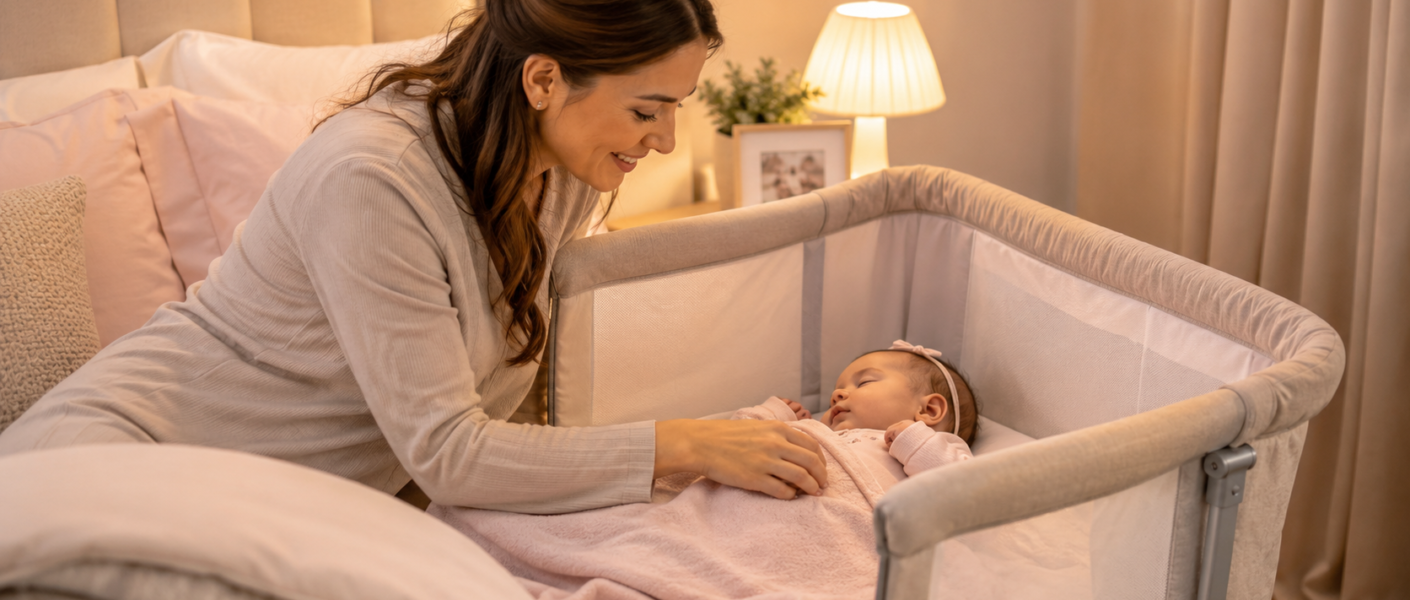
Many parents wonder: Does sleeping in a bedside bassinet make a baby dependent? The most thoughtful answer is no. A bedside bassinet does not “spoil” your baby or create an addiction.
What can happen is that your baby becomes used to a sleep routine built around closeness, comfort, your presence, and quick responses during the night.
That is not a bad habit. It is development, bonding, and adjustment.
In the first months of life, babies are still developing their biological rhythms, nervous system, and ability to calm themselves. Needing closeness does not mean your baby is becoming overly dependent in a harmful way.
International safe sleep recommendations encourage babies to sleep in the same room as their parents, but on a separate, firm, flat sleep surface designed for infants, especially during the first months of life. This is called room sharing, and it is different from bed sharing.
What does it mean when people say a baby gets “used to” a bedside bassinet?
When someone says a baby has gotten “too used to” a bedside bassinet, they usually mean the baby sleeps better near the parents and has a harder time adjusting to a different sleep space.
But the word “addicted” is not appropriate in this context.
Addiction involves chemical or behavioral dependency that causes harm or loss of function. Baby sleep, on the other hand, is shaped by brain development, feeding needs, comfort, routine, temperament, and caregiver responses.
What may develop is a sleep association.
This means your baby learns that sleep happens in a certain setting, with certain cues: your closeness, your scent, your voice, gentle touch, feeding, or a familiar bedtime routine.
Are sleep associations always a problem?
No. Sleep associations are only a problem when they create significant stress for the family or make it very difficult for the baby and caregivers to get enough rest.
Every baby develops sleep associations.
Some babies associate sleep with being held. Others associate it with nursing, rocking, a pacifier, a dark room, white noise, or the presence of a parent nearby.
The goal is not to remove every sleep association. The goal is to build a routine that is predictable, safe, loving, and realistic for your family.
Research on infant sleep shows that consistent bedtime routines are linked with better sleep patterns, fewer night wakings, and more predictability for children.
Best Bedside Bassinet
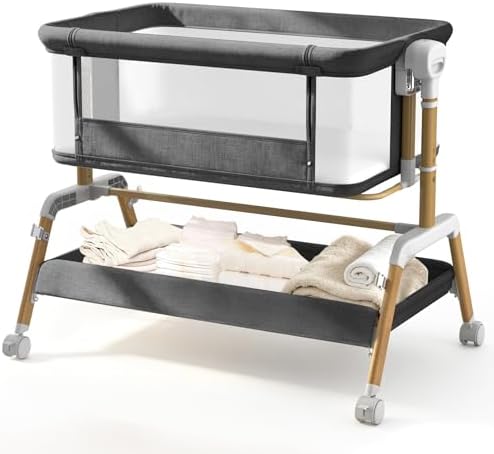
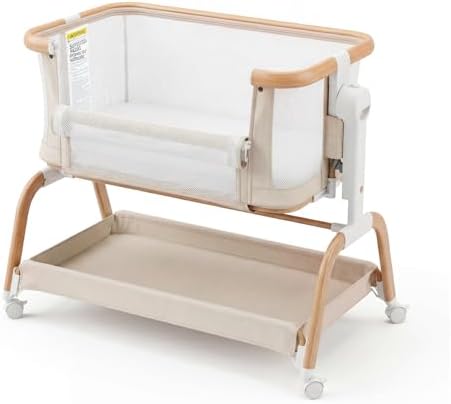
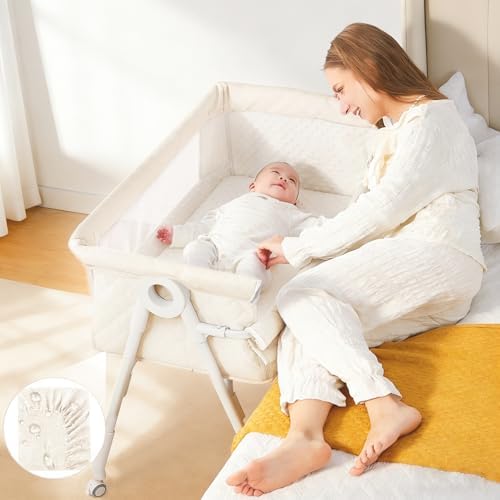
Why do babies often sleep better close to their parents?
Newborns are born neurologically immature.
Their circadian rhythm, which helps organize sleep and wake times throughout the day, is still developing. Their sleep cycles are also shorter than adult sleep cycles, with more time spent in lighter stages of sleep.
Being close to parents can help babies feel secure. It can also make nighttime feeding easier and allow caregivers to notice signs of discomfort more quickly.
For many families, this makes the night feel calmer and more manageable, especially in the early months.
The American Academy of Pediatrics recommends that babies sleep in the parents’ room, on a separate sleep surface, ideally for at least the first 6 months. This practice is associated with a lower risk of sleep-related infant deaths.
Does a bedside bassinet hurt a baby’s sleep independence?
Not necessarily.
Sleep independence does not come from sudden separation. It develops gradually through maturity, routine, and emotional security.
A young baby is not manipulating parents by wanting closeness. A baby is communicating a need.
Over time, as your baby grows, their body becomes more stable, their sleep patterns become more organized, and they may handle sleep transitions more easily.
A bedside bassinet can be part of a healthy, safe sleep routine when it is used correctly and when it fits your baby’s age, size, and development.
Is a bedside bassinet safe for sleep?
A bedside bassinet can be safe when it is used properly and when the product meets current safety standards.
Your baby should always sleep on a firm, flat, non-inclined surface. The sleep space should be free of pillows, loose blankets, bumper pads, sleep positioners, stuffed animals, and soft objects.
The American Academy of Pediatrics emphasizes that any infant sleep surface should meet safety standards for cribs, bassinets, play yards, or bedside sleepers.
It is also important to make sure there are no gaps between the mattress and the sides of the sleep space. Gaps can increase the risk of entrapment.
What is the difference between a bedside bassinet and bed sharing?
In a bedside bassinet, your baby sleeps close to you but on their own separate sleep surface.
With bed sharing, the baby sleeps on the same surface as an adult.
This difference matters.
Organizations such as the NIH Safe to Sleep campaign, the CDC, and the American Academy of Pediatrics recommend that babies sleep in the parents’ room, but not in the parents’ bed.
Babies should always be placed on their backs for sleep, on a safe, firm, flat surface designed for infants.
Can sleeping close to parents disrupt a baby’s sleep?
It can for some families, but it can help others. There is no single rule that applies to every baby.
Some babies wake more often when they sense their parents nearby. Others settle more easily because they feel close and secure.
Your baby’s temperament, nighttime routine, feeding pattern, sleep environment, and the way you respond to wake-ups can all make a difference.
Night waking is very common during the first year of life.
Younger babies often need more caregiver help to fall back asleep. As babies grow, many gradually develop a stronger ability to self-soothe.
Does a parent’s presence always make sleep worse?
No.
A calm, sensitive parent presence can reduce stress and help a baby settle into sleep.
The problem is usually not closeness itself. The issue is when nighttime responses become too stimulating.
Bright lights, playful interaction, too much talking, or picking the baby up immediately for every tiny movement may make it harder for the baby to understand that nighttime is for sleep.
A calm, brief, predictable response can help your baby begin to learn the difference between night and day.
Over time, this supports healthier sleep habits.
When should you transition out of a bedside bassinet?
You may need to transition when your baby outgrows the product’s weight or height limit.
You should also consider a change when your baby begins to sit up, push up, pull to stand, roll in ways that make the product unsafe, or show signs of trying to climb.
Some families also choose to transition because everyone is sleeping better with a different arrangement.
This change does not need to become a test of independence. Your baby can adapt gradually and gently.
How can you make the transition easier?
Start by keeping the same bedtime routine.
For example, you might keep the same bath, dim lights, feeding, cuddles, lullaby, white noise, or bedtime phrase.
Then change only the sleep location while keeping the other familiar cues in place.
If possible, make the transition in steps. You might first move the bedside bassinet slightly farther from your bed. Later, you may place the crib or bassinet in another part of the same room. Eventually, when it feels right for your family, you can consider moving your baby to a separate room.
Consistency matters.
Transitions are often harder during illness, travel, teething, major routine changes, or developmental leaps.
What should you consider if your baby only sleeps in the bedside bassinet?
First, notice whether your baby truly only sleeps there, or whether the bigger challenge is how your baby falls asleep.
Sometimes the issue is not the bassinet itself. It may be the sudden loss of every familiar sleep cue at once.
It is also worth considering hunger, reflux, gas, nasal congestion, room temperature, noise, overstimulation before bedtime, and nap timing.
For babies 4 to 12 months old, the American Academy of Sleep Medicine recommends 12 to 16 hours of total sleep in 24 hours, including naps. Still, every baby is different, and normal sleep needs can vary.
If your baby’s sleep seems unusually difficult, or if you are worried about breathing, feeding, reflux, growth, or safety, it is always wise to talk with your pediatrician.
Conclusion: Closeness is not a bad habit. It is security in progress.
So, does sleeping in a bedside bassinet create a bad habit for your baby?
No.
A bedside bassinet can create familiarity and sleep associations, but that does not mean your baby is spoiled, addicted, or unable to become more independent over time.
In the first months of life, closeness, predictability, and loving responses help babies feel safe.
As your baby grows, that sense of safety can actually support smoother transitions, especially when parents respect the baby’s development and keep routines consistent.
Infant sleep is not only about independence.
It is also about safety, bonding, development, and gradual adjustment.
International References
American Academy of Pediatrics — Safe Sleep Recommendations:
https://publications.aap.org/pediatrics/article/150/1/e2022057990/188304/Sleep-Related-Infant-Deaths-Updated-2022/
AAP — Evidence Base for Safe Infant Sleeping Environment:
https://publications.aap.org/pediatrics/article/150/1/e2022057991/188305/Evidence-Base-for-2022-Updated-Recommendations-for
NIH / Safe to Sleep — Safe Sleep Environment:
https://safetosleep.nichd.nih.gov/reduce-risk/safe-sleep-environment
CDC — Helping Babies Sleep Safely:
https://www.cdc.gov/reproductive-health/features/babies-sleep.html
PubMed — Night waking, sleep-wake organization, and self-soothing:
https://pubmed.ncbi.nlm.nih.gov/11530895/
PubMed — Bedtime routines and objectively assessed sleep in infants:
https://pubmed.ncbi.nlm.nih.gov/34245182/
CDC / AASM Sleep Duration Recommendations:
https://www.cdc.gov/sleep/about/index.html
Most Read Posts

Postpartum Care

Baby Sleep

Breastfeeding

Infant Formula

Baby Bottles

Feeding Your Baby

Diapering & Bathing

Health & Development

Milestones & Development

Colic & Fussiness

Baby Gear & Safety

Traveling with Baby
Recent posts
- Liquid vs. Powder Baby Formula: Which Is the Better Value?
 Compare liquid vs. powder baby formula, including cost, convenience, safe preparation, storage, and which option may be best for your baby.
 - How Do I Know If I’m Ready to Care for a Newborn?
 Learn how to know if you’re ready to care for a newborn, with gentle guidance on feeding, safe sleep, warning signs, and emotional support.
 - First Baby: What If I Feel Lost in the First Few Days?
 Feeling lost with your first baby? Learn what is normal in the first newborn days, when to ask for help, and how confidence grows with time.
 - Is a Folding Stroller Durable Enough for Everyday Use?
 Is a folding stroller durable enough for everyday use? Learn what affects strength, safety, weight limits, and long-term performance.
 - Pregnant for the First Time: What Should You Do in the First Few Weeks?
 Pregnant for the first time? Learn what to do in the first few weeks, including prenatal care, nutrition, folic acid, and warning signs.
 - How to Support Your Partner During Labor and Delivery
 Learn how to support your partner during labor with practical tips for comfort, communication, pain relief, and emotional reassurance.
 - Can a Bedside Sleeper Help First-Time Moms?
 Can a bedside sleeper help first-time moms? Discover its benefits, safety tips, and how to choose the right option for your baby.
Click here to read the article in Portuguese

I’m Cris Coelho, and motherhood has transformed my life!
As a speech therapist and early childhood educator, I’ve always been passionate about child development. But it was becoming a mother that truly opened my eyes to the real challenges and joys of this journey.
Here at Materníssima, I share everything I’ve learned — blending professional knowledge, real-life experience, and a heartfelt touch.
You’re very welcome here! 💕